
Calculating the selling price on Amazon sounds simple until you actually try to do it.
New sellers read blogs, watch videos, use calculators, and still walk away unsure whether they’ll make a profit or a loss.
One formula says one thing, another video says something else, and Amazon’s own numbers don’t always feel clear.
This confusion usually leads to underpricing, panic, or unexpected losses after the first settlement.
This article exists to clear that confusion, not with shortcuts, but with honest, practical clarity about how the selling price really works on Amazon.
If You’re Thinking “Let Me Just Calculate the Price and Start Selling”, Pause Here
This thought is extremely common, and it feels logical. ‘Selling price nikal li, margin dikha, product launch kar diya’ simple. The problem is that Amazon doesn’t behave in a simple, predictable way for new sellers.
Pricing on Amazon is not just about whether the math works once; it’s about whether it survives after fees fluctuate, ads become necessary, returns happen, and sales don’t move as fast as expected.
Most new sellers rush this step because they want certainty before starting. Ironically, rushing the selling price creates more uncertainty later.
The price that looks “profitable” on day one often starts feeling tight after the first few orders, and confusing after the first settlement. That’s when doubt creeps in: Did I calculate something wrong? Did I miss a cost?
Pausing here matters because the selling price is not a finish line; it’s a safety net. If it’s calculated without room for mistakes, learning, and unpredictability, even a good product can become stressful to sell.
This article helps you slow down at the right moment, so you don’t have to panic later.
Why Selling Price on Amazon Is More Confusing Than It Looks

The confusion starts because Amazon doesn’t have just one price. There is MRP, there is the listed price, and then there is the price at which the product actually sells after discounts, offers, or Buy Box adjustments.
Most new sellers assume these are just labels for the same thing. They’re not.
On Amazon, fees are calculated on the actual selling price, not on what you intended to sell at. A small discount or automatic price change can quietly reduce your revenue while your costs stay the same.
This is why many new sellers feel confident before launching and confused after their first few orders.
Another layer of confusion is that Amazon costs don’t behave consistently. Fees vary by category, fulfilment method, weight, size, and sometimes even timing.
Add advertising, returns, and storage into the mix, and the selling price stops being a clean calculation. It becomes a moving target, which is exactly why it feels harder than it looks at first.
The Generic Advice You’ll See Everywhere (And Why It Sounds Right)
Once you start searching for Amazon’s selling price, a clear pattern appears. Almost every blog, video, or guide follows the same structure – first a simple formula, then a quick example, and finally a reassurance that you can calculate profit easily before selling. This advice feels comforting, especially when you’re new and looking for clarity.
The reason it sounds right is that it is logical on the surface. It reduces a complex problem into something measurable and predictable.
For someone just starting, this kind of certainty feels necessary. However, this same simplicity is also where the problem begins.
To understand why, it’s important to first look at what this common advice actually says and then examine why it doesn’t always hold up once real selling starts.
The common formula most blogs and videos repeat
Most beginner guides present the selling price as a straightforward calculation: product cost plus Amazon fees, with a profit margin added on top.
This formula is usually shown with clean numbers and perfect scenarios, making it feel reliable and easy to apply. For someone new, it creates the impression that once this math works, the business will work too.
The simplicity is intentional; it lowers fear and makes starting feel less risky than it actually is.
Why this advice fails beginners in real life
This advice fails because it assumes everything goes according to plan. In real selling, costs do not stay stable, and sales do not behave predictably.
Advertising becomes necessary sooner than expected. Discounts get applied automatically. Returns happen even when the product is fine.
Fees change based on weight slabs and fulfilment conditions. Beginners follow the formula correctly and still feel confused when profits shrink.
The issue is not calculation skills. The issue is that the advice ignores uncertainty, which is a permanent part of selling on Amazon.
What “Selling Price” Actually Means on Amazon (In Practical Terms)
On Amazon, the selling price is not what you intend to sell at. It is what the customer actually pays at the moment of purchase.
This sounds obvious, but it’s where many beginners slip.
You may list a product at one price, set an MRP higher, and still end up selling at a lower price because of discounts, Buy Box adjustments, or promotional offers you didn’t actively plan.
The key practical point is this: Amazon calculates most fees based on the final transaction value, not on your MRP or on the price you had in mind when doing the calculations.
That gap between intention and reality is what creates confusion later.
Experienced sellers stop thinking in terms of “my price” and start thinking in terms of “my realised price after everything.” Once you make that shift, pricing decisions become clearer, and surprises reduce significantly.
If you’re planning to sell on multiple platforms, this confusion is not limited to Amazon. Meesho works differently, and pricing there requires a separate approach. You can understand that clearly in our guide on how to calculate selling price on Meesho, before assuming the same logic applies everywhere.
Selling Price Calculation Is Not a Math Problem, It’s Risk Management
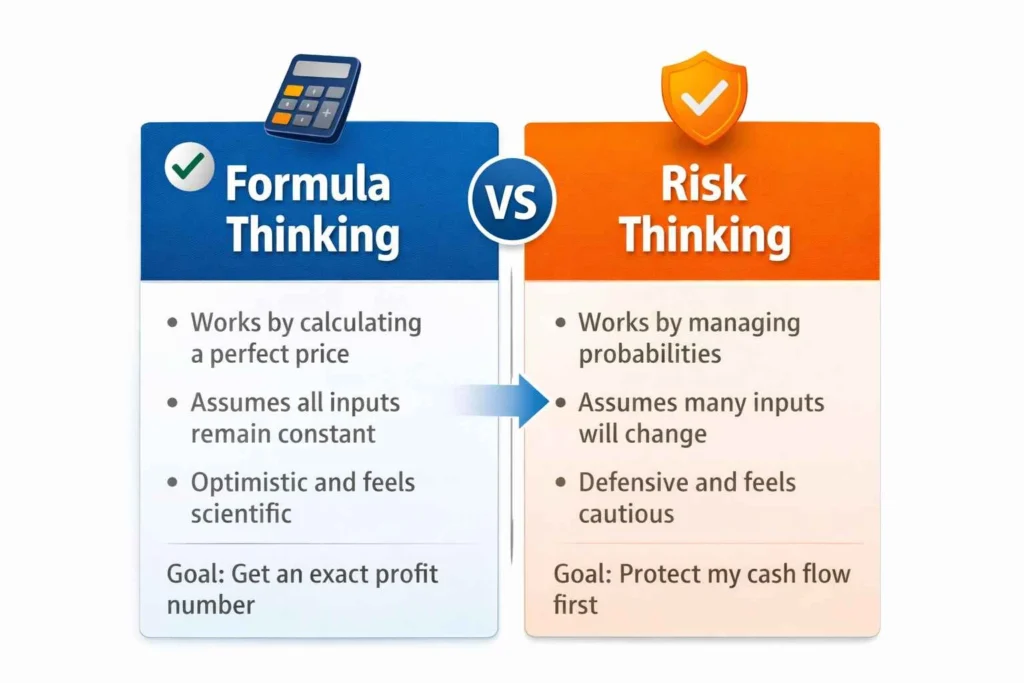
Most new sellers approach the selling price like an exam question. Put the numbers in the formula, get the right answer, move on.
That mindset works only if everything stays stable, which rarely happens on Amazon.
In reality, pricing is about how much risk your business can absorb when things don’t go as planned.
Ads may cost more than expected. Sales may be slower. Returns may spike. Fees may change slightly without warning.
A selling price that only works in the best case will fail the moment any of these happen. That’s why experienced sellers don’t look for the perfect number.
They look for a price that can survive uncertainty. When pricing accounts for risk, not just margin, the business feels far more controllable and far less stressful.
Pricing decisions are closely tied to risk and cash-flow management, not just margins, which is why pricing strategy is often discussed in the context of business risk rather than simple calculations.
All the Costs You Must Consider Before Deciding Your Selling Price
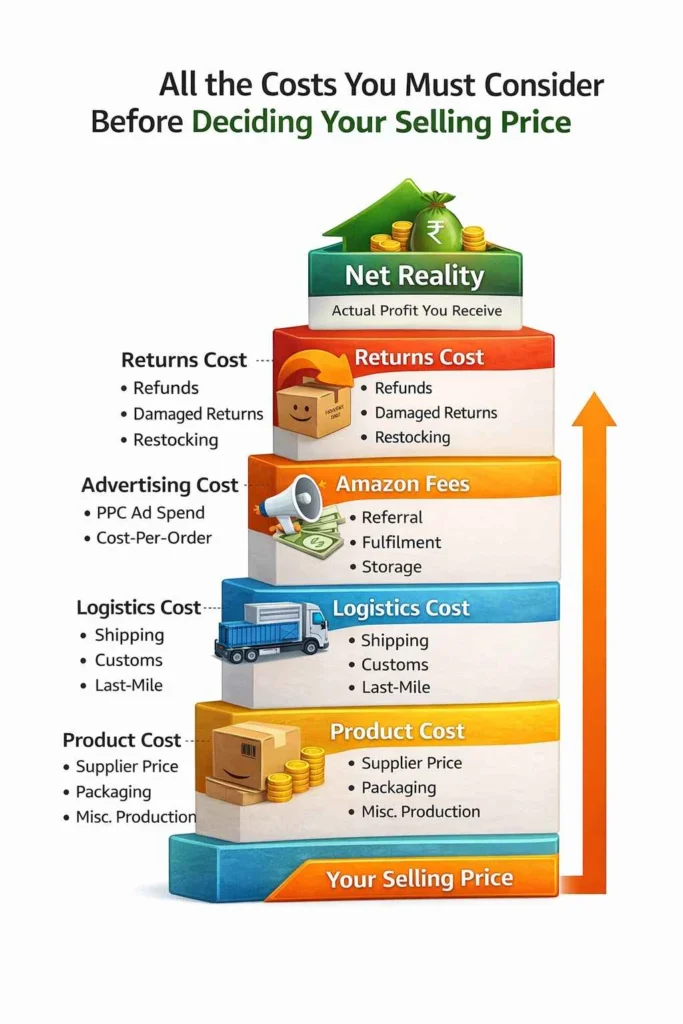
This is where most new sellers realise that their original price calculation was incomplete. Amazon’s selling does not have one cost. It has layers of costs, and missing even one layer can turn a profitable-looking price into a loss-making one.
Here are the costs that actually matter in real selling, not just in theory:
Product cost (COGS) and what beginners usually forget
Most sellers count only the supplier price. Real product cost also includes packaging, labelling, barcodes, minor defects, and wastage.
These small amounts look harmless individually, but quietly reduce the margin when multiplied across units.
Inbound logistics cost before Amazon gets involved
Shipping costs are rarely as clean as expected.
Rates fluctuate, cartons get charged by volume, not logic, and last-mile surprises happen.
Beginners often budget ideal shipping costs, not realistic ones, which distorts selling price calculations early.
Amazon referral, fulfilment, and closing fees
Referral fees vary by category and are charged as a percentage of the actual selling price. Fulfilment fees depend on product size, weight, and whether you use FBA or FBM, and they can change if your product moves to a different slab.
In addition to these, Amazon also charges a fixed closing fee per order, which applies regardless of your margin.
This fee is small in value but becomes significant for low-priced products and is often missed by new sellers while calculating the selling price.
Assuming fees will remain constant is a common beginner mistake, which is why it’s important to cross-check costs directly fromAmazon’s official fee documentation.
GST and tax impact on selling price
GST is charged on the selling price, not on profit. While input credit helps, cash flow still takes a hit initially.
Many beginners feel profitable on paper but struggle because they didn’t plan pricing with tax timing in mind.
Advertising costs that most beginners don’t plan for
New listings rarely sell consistently without ads.
Even modest advertising spend increases cost per order. Sellers who ignore ads while pricing often feel forced to choose between visibility and profit after launch.
Returns, refunds, and invisible leakage
Returns reduce realised revenue, not just inventory. Some fees don’t get refunded fully, and damaged returns add silent losses.
These costs don’t show clearly in calculators but appear steadily in real seller accounts.
Why Amazon Profit Calculators Don’t Match Real Results
Amazon profit calculators are designed to give estimates, not reality. They work on the assumption that the inputs you enter are complete and stable.
In real selling, they rarely are. Most calculators do not automatically include advertising spend, return-related losses, long-term storage fees, or fluctuating fulfilment charges.
They also assume your product sells at the same price consistently, which often doesn’t happen due to discounts and Buy Box changes.
Many sellers feel misled, not because calculators are wrong, but because they expect precision where only approximation is possible.
Experienced sellers use calculators as a starting point, not as proof of profitability.
Calculators are useful only when you understand what they include and what they don’t. If you want to test different scenarios realistically instead of chasing perfect numbers, you can use our Amazon price calculator as a reference tool while keeping real-world variables in mind.
Competitive Pricing vs Profitable Pricing (The Trap New Sellers Fall Into)
| Competitive Pricing Mindset | Profitable Pricing Mindset |
| Focuses on being the cheapest option | Focuses on being a sustainable option |
| Copies competitor prices blindly | Calculates price based on own costs |
| Prioritises quick sales | Prioritises long-term survival |
| Assumes volume will fix low margins | Accepts slower sales for better control |
| Panics when ads become expensive | Expects ad cost as part of selling |
| Relies heavily on discounts | Uses discounts strategically |
| Feels successful seeing orders | Feels secure seeing stable margins |
| Breaks when fees increase slightly | Absorbs fee changes calmly |
| Creates stress after settlements | Creates predictability in cash flow |
| Often leads to burnout or exit | Allows learning and gradual scaling |
A Practical Way to Think About Selling Price (Without Chasing a Perfect Formula)
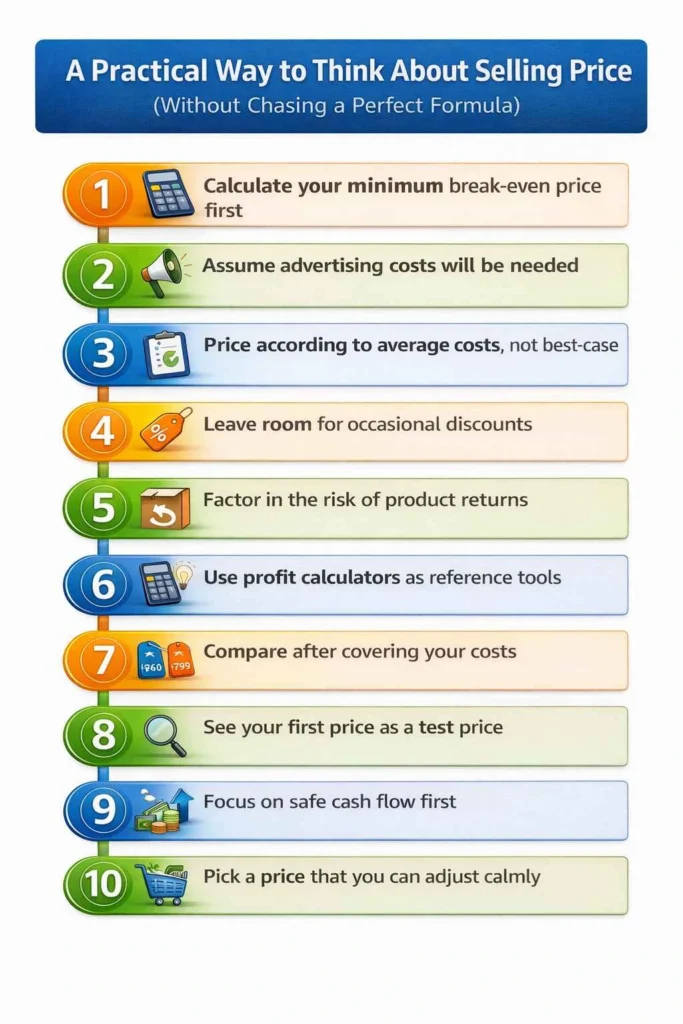
- Start by calculating the minimum price at which you can sell without losing money, not the price you hope to sell at.
- Assume that advertising will be required, even if you plan to rely on organic sales initially.
- Build your price around average and realistic costs, not best-case scenarios.
- Account for all Amazon fees, including referral fees, fulfilment fees, and fixed closing fees per order, especially if you’re pricing low.
- Leave room for discounts, because Amazon pricing rarely stays static in real selling.
- Expect some percentage of returns and factor that risk into your thinking upfront.
- Treat calculators as reference tools, not final decision-makers.
- Compare your price with competitors only after your own costs are fully covered.
- Accept that your first selling price is a learning price, not a final one.
- Protect cash flow before chasing high margins, and choose a price that lets you sell calmly even when numbers fluctuate.
Example: Amazon Selling Price Calculation (India)
Assume:
- Product category: Home & Kitchen
- Fulfilment: Amazon FBA
- Selling price (customer pays): ₹999
Product & Inbound Costs
- Product cost (COGS): ₹350
- Packaging + labeling: ₹20
- Inbound shipping to Amazon: ₹30
Subtotal: ₹400
Amazon Fees (as per official structure)
- Referral fee (approx. 15% of selling price)
15% of ₹999 = ₹150
- FBA fulfilment fee (size & weight-based)
Assume: ₹120
- Closing fee (fixed per order)
Assume: ₹10
Amazon fees total: ₹280
Advertising & Leakage (realistic assumption)
- Ads cost per order (initial phase): ₹80
- Returns / misc buffer: ₹20
Subtotal: ₹100
Total Cost Summary
| Component | Amount |
| Product + logistics | ₹400 |
| Amazon fees | ₹280 |
| Ads + buffer | ₹100 |
| Total cost | ₹780 |
Net Outcome
- Selling price: ₹999
- Total cost: ₹780
Approx net before tax: ₹219 per order
Common Pricing Mistakes New Amazon Sellers Repeatedly Make
- Pricing the product based on what feels competitive instead of what is actually sustainable
- Ignoring advertising cost while assuming organic sales will come automatically
- Trusting a single calculator result without understanding what it excludes
- Copying competitor prices without knowing their cost structure or margins
- Setting prices that work only if everything goes perfectly
- Forgetting that discounts reduce realthe ised selling price, not Amazon fees
- Underestimating the impact of returns and refund-related losses
- Believing that higher sales automatically mean higher profit
- Adjusting prices emotionally after a few slow days
- Starting with aggressive pricing and having no room to recover later
Many sellers assume that getting orders automatically means they are doing well. In reality, this is one of the biggest traps in e-commerce.
We’ve explained this in detail in why most e-commerce sellers lose money despite getting orders, because pricing mistakes don’t always show up immediately.
What Most People Don’t Tell You
What rarely gets said openly is that the selling price on Amazon is not something you calculate once and forget. It keeps changing, even when you don’t touch it.
Fees fluctuate, ads behave unpredictably, discounts get triggered, and returns quietly eat into revenue. Most of the people usually present pricing as a clean pre-launch task.
Seller discussions show it as an ongoing adjustment.
Another uncomfortable truth is that early profits are often misleading. Many new sellers feel confident after a few good orders, only to realise later that storage costs, ad spend, or refunds have slowly reduced margins. This is why some sellers are saying “sales are coming, but money isn’t”.
Most people also don’t say that the first product is rarely about profit. It is about learning how Amazon actually behaves.
Those who survive are not the ones with perfect formulas, but the ones who priced with caution and stayed mentally prepared for surprises.
This is also why the question is no longer just “how to price”, but whether the business model itself fits your expectations.
If you’re unsure about long-term sustainability, our reality check on whether e-commerce is still profitable in India will help you see the bigger picture beyond pricing formulas.
Before You Finalize Your Selling Price, Ask Yourself These Questions
- Can this price survive if advertising costs are higher than expected
- Will I still be comfortable selling if sales are slower in the first few weeks?
- Have I calculated the price using average costs instead of best-case assumptions
- Am I prepared for returns without panicking or changing price emotionally?
- Does this price protect my cash flow, not just my margin
- Have I left room for discounts without entering a loss?
- Am I pricing based on my costs or copying competitors blindly
- Can I handle small fee changes without this price breaking
- Do I understand how much I actually earn per order after everything
- ?If this price fails, do I have room to adjust without starting over
Final Advice for New Amazon Sellers (From Someone Who Learned the Hard Way)
The biggest mistake new Amazon sellers make is believing that confidence should come before clarity. In reality, clarity comes first, and confidence follows later. Selling price is not about proving that a product will work.
It is about protecting yourself while you learn how the platform actually behaves. Those who price aggressively to feel competitive often burn out faster than those who price conservatively and stay in control.
It is also important to accept that no calculation will feel perfect. Amazon has too many moving parts for that.
What matters is whether your price gives you enough breathing room to handle ads, returns, slow sales, and small surprises without stress.
A calm seller makes better decisions than an anxious one.
If there is one mindset that helps beginners survive, it is this: treat pricing as a safety mechanism, not a profit promise. Those who survive long enough to learn are the ones who eventually earn well.