
If you sell on Meesho, you’ve heard the pitch: zero commission, easy to start, beginner-friendly.
Then the payouts start coming in, and the number in your bank account doesn’t match the number you expected.
This isn’t bad luck. It’s a pricing problem — and it starts in exactly one place: how you calculate your selling price before you list the product.
Meesho’s pricing model is not the same as Amazon’s or Flipkart’s. If you’re pricing it like those platforms, you are almost certainly leaking margin without noticing. This guide walks through the exact formula, the costs sellers forget, a full worked example with real numbers, and a free calculator to check your own product right now.
Why Selling Price Calculation on Meesho Is Different From Other Marketplaces
Most Meesho pricing mistakes come from habits carried over from other platforms.
On Amazon or Flipkart, the logic is simple: you set a final price, the platform deducts commission and fees, and you keep the rest.
Meesho flips this. You don’t set the final customer-facing price directly; you enter a Supplier Price, and Meesho builds the customer-facing price on top of it by adding shipping, GST on that shipping, and return-related adjustments.
The second difference is commission. “Zero commission” sounds like free money, but it isn’t. Meesho replaces commission with logistics costs. Shipping and returns are where your margin actually goes — not a percentage cut, a cost structure. Sellers who don’t account for this end up with prices that look fine and profits that quietly aren’t.
Once you separate “what I enter” from “what the customer sees” from “what lands in my bank,” Meesho pricing stops being confusing.
How Meesho Actually Decides the Final Customer Price
When you enter a price in the Meesho Seller Panel, that’s your Supplier Price — your base number, covering cost, expected profit, and a return buffer. It is not what the customer pays.
The customer-facing price is your Supplier Price plus several layers Meesho adds automatically:
- Shipping — calculated by product weight and delivery distance, then folded into the shown price so it looks like “free delivery.”
- 18% GST on that shipping — a mandatory, always-on charge, separate from the GST on your product.
- Return policy adjustment — if you allow “All Returns,” the shown price is higher than if you restrict to “Only Wrong or Defective Returns,” because Meesho is pricing in the extra return risk.
- Real-time discounts, coins, and promotions — meaning two customers can see two different prices for the identical product at the identical moment.
The practical takeaway: your control stops at the Supplier Price. Everything after that — the number the customer sees, and the number that eventually hits your bank — is shaped by Meesho’s logistics and pricing engine. This is also exactly why the amount in your bank account is rarely the number you were mentally expecting.
All Costs You Must Consider Before Setting a Selling Price on Meesho
A selling price isn’t “a number that looks competitive.” It’s the sum of every cost that quietly touches your payout. Miss one, and the price looks right while the profit disappears.
Direct Product and Procurement Cost

Your base cost: what you pay to buy or manufacture the product, plus inward freight if you’re sourcing from a supplier, plus raw material and labour if you manufacture it yourself. Sellers who only count the product’s sticker rate and skip freight or labour are underpricing from step one.
Packaging and Labelling Expenses

Packaging is a real, recurring cost — polybags, tape, labels, boxes. It’s also a hidden loss centre: when a return happens, packaging is usually damaged and can’t be reused. Build a small per-order packaging buffer for this; don’t treat it as a one-time cost.
Return and RTO Buffer

This is the single most important cost on Meesho, and the one new sellers ignore the longest.
A customer return triggers return shipping charges — a direct hit to your margin. RTO (return to origin, when a delivery attempt fails) is different: shipping may not be charged in full, but your inventory gets blocked, packaging is wasted, and your sales cycle resets. Price without a return/RTO buffer, and one bad week can erase a month of “profit.”
Marketing and Advertising Spend

If you run Meesho Ads, that’s a real cost against every order the ad touches — not a separate line item you can ignore in your pricing. Calculate an average ad cost per order and fold it in. Ads should grow your business, not quietly convert it into a loss-maker.
Taxes and Statutory Deductions

GST is not your money and never was — it belongs to the government from the moment it’s collected. Beyond GST, TDS and TCS deductions also apply. They’re recoverable later when you file returns, but in the short term, they reduce your cash flow, which is exactly why payouts feel smaller than the “selling price” suggests.
Operational and Miscellaneous Costs

Rent, electricity, staff, internet, printers, daily consumables — none of these shows up in a single order’s math, but they have to be covered by your overall pricing and volume. Ignore them at the per-order level, and they’ll show up as a business-level loss instead.
The rule that ties all of this together: your selling price has to cover every cost above before a single rupee counts as profit. Sellers who price this way stop being surprised by their payouts.
The Biggest Pricing Mistakes New Meesho Sellers Make
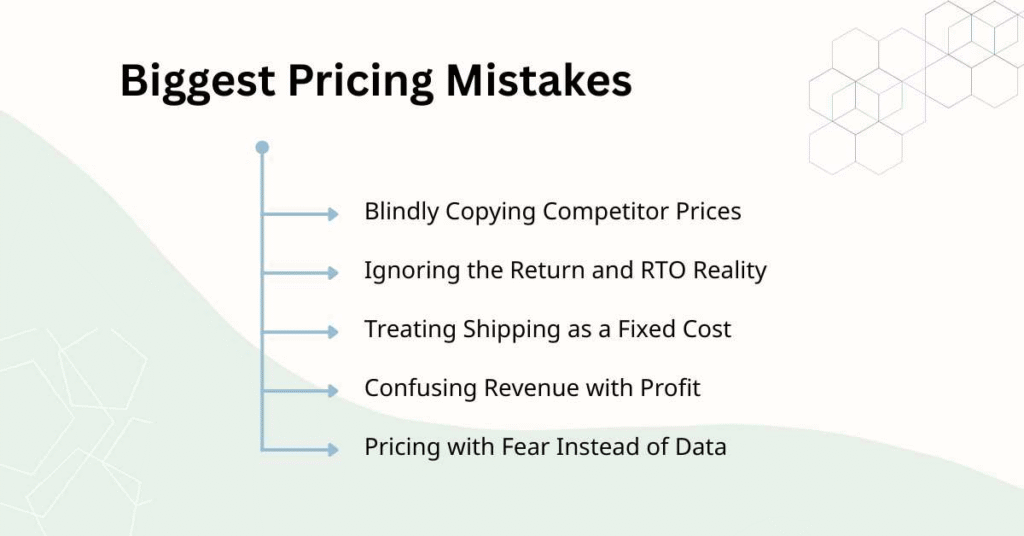
Blindly Copying Competitor Prices
A competitor’s lower price usually has a reason behind it — maybe they’ve restricted returns to “Only Wrong or Defective,” maybe they’re in a lower weight slab, maybe they operate at a scale that changes their cost base. Copying the number without copying the math behind it is how sellers walk straight into a loss.
Ignoring the Return and RTO Reality
Returns aren’t an edge case on Meesho — they’re a built-in part of the system. If your price doesn’t include a return/RTO buffer, one ₹200 return can wipe out the profit from several good orders. This is unit economics, not bad luck, and it’s entirely predictable if you price for it upfront.
Treating Shipping as a Fixed Cost
Shipping is variable, not fixed. A small change in packaging size or product weight can push you into a higher weight slab — and with it, higher shipping and higher GST on that shipping. Sellers who assume shipping is a flat number get blindsided by shrinking payouts.
Confusing Revenue with Profit
Orders coming in and money hitting your account both feel like success. But that’s cash flow, not margin. Without tracking net settlement per order, you can move thousands of units and still see no real growth in your bank balance. Revenue is a dashboard number. Profit is the number that decides whether the business survives.
Pricing with Fear Instead of Data
Keeping prices low out of fear of losing orders is the most expensive mistake on this list. It leads to thin margins, higher return rates, and weaker account health — a short-term order bump that costs you long-term growth. Sustainable pricing comes from knowing your costs cold, not from reacting to whatever a competitor just did.
How to Calculate a Safe Selling Price on Meesho (Conceptual Explanation)
Safe pricing means your net profit survives returns and ad spend — every time, not just on the good days. Think in three layers, not one final number.
Layer 1: The Foundation (Hard Costs): Product cost, plus packaging (typically ₹5–₹10 per order), plus GST on the product. Meesho prices are GST-inclusive — the GST portion is never yours; mentally subtract it before you even start thinking about margin.
Layer 2: The Variable Risk Layer. A customer return typically costs ₹150–₹200 in return shipping. Build a small buffer — ₹30–₹40 — into every order so one return doesn’t cancel out five good ones. If you’re running ads, add your average ad cost per order (usually ₹15–₹20) here too.
Layer 3: Platform and Tax Layer Shipping isn’t free for you even when it’s shown as free to the customer — and 18% GST applies on top of that shipping cost. Before you finalize anything, check the transfer price in your dashboard. That number — not the customer-facing price — is what safe pricing should be built from.
A Simple Example to Understand Meesho Selling Price Calculation
Let’s price a women’s kurti, step by step, with real numbers.
Step 1 — Base Cost Buying price: ₹250 Packaging: ₹10 Total Base Cost: ₹260
Step 2 — Build the Internal “Safe” Price Expected profit: ₹50 Return buffer: ₹40 Ads/promotions: ₹10 Internal Working Price (pre-GST): ₹360
Step 3 — Final Panel Price If the kurti sits in the 5% GST slab: GST = ₹18 Meesho Panel Price (what the customer sees): ₹378
Step 4 — The Bank Settlement (Reality Check) Average forward shipping: ₹60 GST on shipping (18%): ₹10.80 Total deduction: ₹70.80 Credit to Bank: ₹307 (approx.)
Step 5 — The Real Net Profit Bank credit: ₹307 Minus base cost: ₹260 Net Profit: ₹47
Notice what happened: the customer paid ₹378, but your actual profit was ₹47 — not the ₹50 you “planned,” because the numbers only reconcile once every layer is accounted for. This is exactly the gap that surprises sellers who price off the panel price alone.
Using a Meesho Price Calculator (When & How to Use It Correctly)
A calculator is a confirmation tool, not a guessing tool. Manually running the five steps above for every SKU doesn’t scale — but skipping the math entirely is how margins quietly disappear. Here’s how to use one correctly:
Step 1: Enter Your Cost Price per Unit — your actual buy/manufacture cost. Get this wrong and every downstream number is wrong too.
Step 2: Select the Product Category — this applies the correct GST rate automatically, so tax and margin never get mixed up.
Step 3: Add Your Shipping Cost — use a realistic number based on actual weight and typical delivery distance, not the cheapest-case scenario.
Step 4: Enter the Expected Return Rate (%) — your calculator should let the return math adjust your safe margin automatically, instead of you finding out the hard way three weeks later.
Step 5: Set Your Desired Margin (%) — this should be your margin after returns, ads, and overhead — not an optimistic headline number.
Step 6: Click Calculate and Review the Full Breakdown — cost, shipping, packaging, return cost, GST, and profit, all separated out, so you can see exactly where the price is safe and where it isn’t.
👉 Use the free Meesho Price Calculator by MarginPanda — plug in your actual cost and category, and see your real numbers in under a minute. This is the one part of this guide a summary can’t do for you: your product, your category, your numbers.
What a “Good” Margin Looks Like on Meesho (Reality Check)
A good margin isn’t a target percentage you pick in advance — it’s whatever number is left standing after returns, shipping, and tax have all taken their cut.
First, forget the idea of “high margin”
Meesho is price-sensitive. Price too high, and orders slow down. Price too low, and shipping plus returns eat everything you made. The goal isn’t the highest margin — it’s a stable one.
What actually counts as healthy, by price band:
- Low-ticket products (₹200–₹400): ₹30–₹50 net margin per order. Small in percentage, but volume carries the business.
- Mid-range products (₹400–₹800): 8%–15% net margin. Enough buffer to absorb a normal return rate without stalling growth.
- Below 8% net margin: a danger zone. One bad return cycle can erase weeks of work.
Gross margin is not the real margin. A 30% margin on paper often turns into something much thinner once you subtract shipping and GST on shipping, returns and RTO losses, packaging, and ad spend. If the number looks good before these costs and weak after them, it was never actually a good margin.
Why do lower but stable margins win on Meesho
Meesho rewards consistency, not aggression. Sellers who price safely handle returns without panic, keep stronger account health, and scale without sudden losses. Sellers who price aggressively get a short burst of orders, absorb higher returns, and struggle to grow past that point.
The real test: if your price still leaves profit after a few returns, active ad spend, and normal shipping costs — it’s a good margin. If profit vanishes the moment anything goes wrong, it was never a good margin to begin with.
Final Advice for New Meesho Sellers
Pricing on Meesho isn’t about looking cheap — it’s about staying in business long enough to grow.
Don’t list at a low price just because a competitor is there first. What shows on the customer’s screen is not what lands in your bank — always think in terms of net settlement, not the visible price.
Treat returns as a normal cost of doing business, not bad luck. If your price can’t survive a handful of returns, it isn’t ready to go live — fix the number before you scale, not after.
Use a calculator to validate decisions, not to avoid making them. The numbers should give you confidence, not just more confusion in a different format.
Sellers who last on Meesho aren’t the ones with the best product — they’re the ones who respected their costs, priced for reality, and grew slowly on purpose.
Reality price. Not for hope.
Frequently Asked Questions
What does “margin” mean on Meesho?
Margin is what you keep after every cost — product, packaging, shipping, GST, returns, and ads — is subtracted from what Meesho actually credits to your bank account. It is not the gap between your cost price and the customer-facing panel price.
Is the listing price on Meesho inclusive of GST?
Yes. The price shown to the customer already includes GST. Sellers should build their internal pricing pre-GST, then add GST on top to arrive at the final panel price — not the other way around.
What is a typical reseller margin per order on Meesho?
For low-ticket products (₹200–₹400), a stable net margin is usually ₹30–₹50 per order. For mid-range products (₹400–₹800), an 8%–15% net margin is considered healthy. Below 8%, a single bad return cycle can erase your profit.
What is the bank settlement amount in Meesho?
It’s the amount Meesho actually credits to your account after deducting forward shipping and GST on that shipping from the panel price the customer paid. It is almost always lower than the panel price — check this number in your dashboard before assuming your pricing is safe.
How do I check if my price is actually safe before listing? Run your cost, category, shipping, and expected return rate through the Meesho Price Calculator. It shows your full cost breakdown and tells you whether your margin survives returns — before you list, not after.