
Calculating the selling price on Flipkart looks simple on the surface, but this is exactly where many sellers make their first costly mistake.
The purpose of this article is not to give you another formula, but to help you understand how the selling price actually behaves on Flipkart once real orders, returns, logistics, and discounts come into play.
Pricing errors on Flipkart rarely show up immediately; they show up slowly, through shrinking settlements and unexplained losses.
This guide is written for sellers who want clarity before committing money, inventory, and time and who prefer realistic decision-making over optimistic assumptions.
If You’re Trying to Calculate Selling Price on Flipkart, Pause Here
Pricing on Flipkart can be confusing, even after using calculators, because those tools show estimates, not outcomes.
They assume stable logistics, predictable returns, and no pricing pressure, which rarely holds once selling begins.
Many sellers make the mistake of just adding commission to their cost and calling it a price.
This approach is risky because Flipkart pricing includes fixed fees, logistics variation, returns, and discount effects that do not scale with price.
Getting pricing wrong does not always lead to immediate failure. It often leads to slow losses, tighter cash flow, and growing doubt about the business, even when orders keep coming.
Why Selling Price on Flipkart Is More Complicated Than It Looks
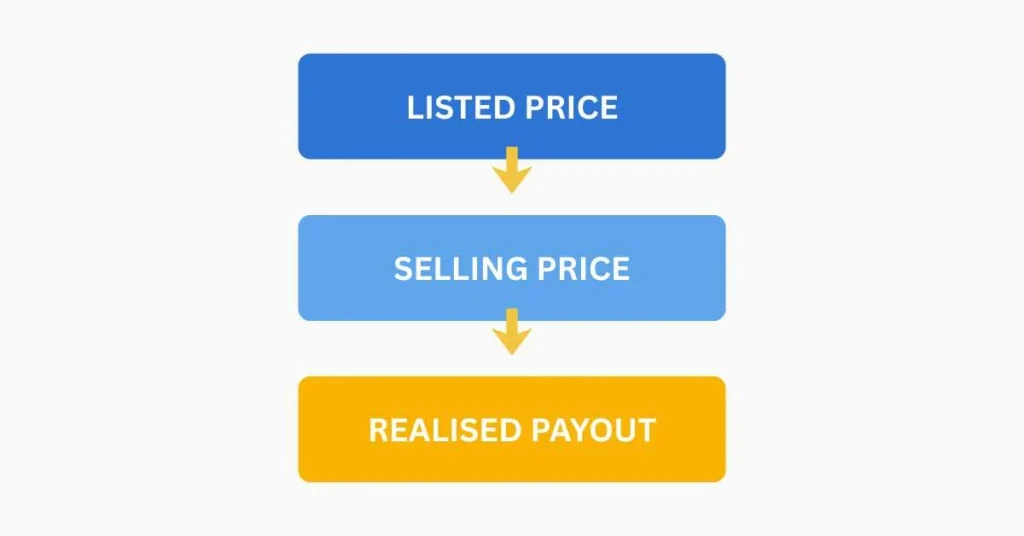
On Flipkart, the price you see and the money you receive are not the same thing. The listed price is what appears on the product page.
The selling price is what the customer actually pays after discounts or offers.
The realised payout is what reaches your bank account after Flipkart deducts commissions, fixed fees, logistics charges, returns, and taxes.
Most sellers calculate pricing using the first number and expect the third to behave proportionally, which is where confusion begins.
Sellers feel confident before selling because calculators and spreadsheets look clean.
Confusion starts after settlements because the payout reflects real-world events like returns, RTO, zone-based shipping, and discount adjustments.
This makes pricing less predictable if risk is not planned upfront.
Flipkart’s logistics and return structure are not the same as Meesho and Amazon’s, which is why selling price calculations cannot be copied across platforms.
If you also sell on Meesho and/or Amazon, this guide on how to calculate the selling price on Meesho and/or Amazon explains those differences clearly.
The Generic Advice You’ll See Everywhere (And Why It Sounds Correct)
Once you start researching Flipkart pricing, you will notice the same advice repeated across blogs, videos, and tutorials. It usually simplifies pricing into a clean calculation that looks logical and reassuring.
This advice sounds correct because it reduces a complex system into something predictable and easy to apply.
For someone new, this sense of certainty feels necessary and comforting, even though it rarely survives real selling conditions on Flipkart.
The common formula most blogs and videos repeat
Most guides reduce Flipkart pricing to a simple equation: cost plus Flipkart fees, with a profit margin added on top.
This advice spreads easily because it is clean, teachable, and quick to explain. Beginners trust it because it creates the feeling that pricing is fully under control before selling starts.
The formula looks logical on paper, especially when calculators show positive numbers, which makes sellers believe the business is already viable.
Why this advice breaks in real Flipkart selling
This formula hides several assumptions that rarely hold in practice. It assumes logistics costs remain stable, returns stay low, and discounts do not affect payouts significantly.
In reality, Flipkart applies fixed fees, zone-based shipping, reverse logistics, and RTO charges that do not scale with price.
The formula also ignores discount participation, where the selling price drops, but many costs remain unchanged.
This is why the calculation looks correct before launch but starts failing once real orders, settlements, and returns begin to reflect actual platform behaviour.
All Charges That Affect Selling Price on Flipkart (Complete Audit)
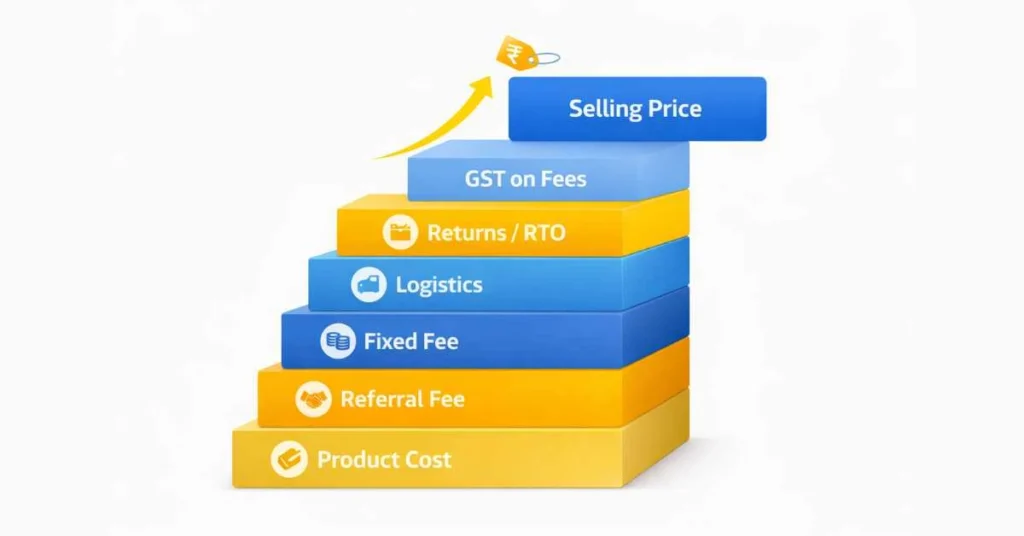
Flipkart’s selling price is affected by more than just commission, and missing even one charge can break your calculation.
This section exists to lay out every charge that directly or indirectly impacts your realised payout, without assumptions or shortcuts.
Each charge below behaves differently depending on price, weight, location, and returns. Understanding how these charges interact is critical because Flipkart pricing does not fail due to one high cost but due to multiple small costs compounding over time.
Referral commission
Referral commission on Flipkart is a category-based percentage charged on the selling price of the product. The percentage varies by category and is applied before most other deductions.
Sellers often misunderstand this fee by assuming it is the primary or only cost. In reality, while referral commission is visible and easy to calculate, it is only one part of the pricing equation.
Many sellers price products assuming that covering commission means covering risk, which leads to losses once fixed fees, logistics, and returns start affecting the final payout.
Fixed fee (per order charge)
Flipkart also charges a fixed fee on every successful order, regardless of the product price or margin.
This fee applies uniformly once an order is completed, which is why low-price products suffer the most.
When the selling price is low, a fixed amount consumes a much larger share of the margin. Sellers often miss this charge because it looks small in isolation and is not highlighted as aggressively as commission.
In reality, this single fee quietly determines whether low-ticket products are viable or not on Flipkart.
Shipping and logistics fees
Flipkart charges separate logistics fees for forward shipping, which depend on the product’s weight slab and the delivery zone.
These fees do not change proportionally with the selling price. A small change in weight category or a shift from local to national delivery can increase logistics costs even when the product price stays the same.
Sellers often assume shipping behaves like a percentage cost, but in reality, it is slab-based, which is why pricing breaks when volume increases or order locations change.
Reverse logistics and RTO charges
Reverse logistics charges apply when a product is returned after delivery, while RTO charges apply when an order is rejected or undelivered and sent back before completion.
Sellers often underestimate RTO because it does not feel like a sale failure, but financially, it is worse than a normal return.
You perform forward shipping and then reverse shipping without earning revenue. This silently kills margin, especially in categories with high rejection rates.
If RTO risk is not priced in advance, even good-selling products can turn unprofitable over time.
Collection and handling charges
Collection and handling charges are applied by Flipkart for processing the order, including payment collection and basic order handling.
These charges are usually fixed or semi-fixed and do not depend on your profit margin.
They are rarely mentioned in pricing guides because they appear small and are bundled inside settlement reports.
However, they directly reduce the realised payout on every order. Over multiple orders, these charges add up and tighten margins, especially when pricing has little buffer to begin with.
Discount participation impact
When Flipkart applies discounts, the selling price paid by the customer goes down, but most fees do not reduce in the same proportion.
Referral commission may decrease slightly, but fixed fees, logistics charges, and handling costs remain largely unchanged.
This creates a gap between expected and realised payout. Sellers often feel cheated because sales increase while profits shrink. The issue is not dishonesty, but misunderstanding.
Discounts improve visibility and volume, but if pricing does not account for them in advance, they quietly erase margins instead of supporting growth.
GST impact on Flipkart fees
Flipkart charges GST on services like referral commission, logistics, reverse logistics, and handling fees.
This GST is deducted from your settlement, which is why profit often looks higher on paper than the actual cash received in your bank.
Sellers commonly misunderstand this by calculating the margin before accounting for GST on fees. While input tax credit may be available, it does not eliminate the immediate cash flow impact.
Ignoring GST timing and applicability leads sellers to overestimate real profitability, especially in the early stages of selling.
Selling Price Calculation Is Not a Math Problem, It’s Risk Management
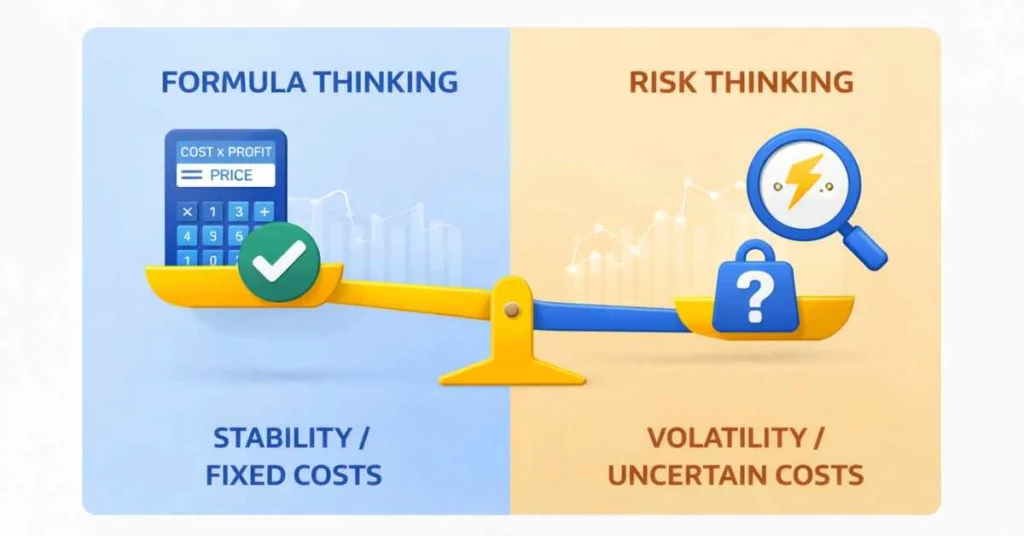
Exact formulas rarely survive on Flipkart because the platform does not operate in controlled conditions.
Logistics costs change by zone, returns and RTO fluctuate by category, discounts get applied without warning, and fixed fees remain constant regardless of selling price.
A formula that works in one week can quietly fail the next without any visible mistake from the seller’s side.
This is why experienced sellers think in price ranges, not exact numbers.
Instead of asking “What is my profit at this price?” they ask “How much downside can this price absorb?” They assume that returns will happen, logistics will vary, and discounts will eventually apply.
Pricing is designed to survive these events, not ignore them.
On Flipkart, pricing must protect against worst-case scenarios. A price that only works when everything goes right is not a strategy.
Pricing decisions are closely tied to risk management and cash flow, not just margins, which is why pricing strategy is often discussed in the broader context of business sustainability rather than simple cost-plus formulas.
It is a gamble. Sellers who survive long term price for uncertainty first, profit second.
A Practical Way to Think About Selling Price on Flipkart (Step-by-Step)
- Start from the minimum survivable price – Calculate the lowest price at which you can sell without losing money, not the price you hope to sell at.
- Add all mandatory Flipkart charges – Include referral commission, fixed fee, logistics, collection, and handling charges without exception.
- Assume returns and RTO will happen – Treat returns and RTO as expected costs, not rare events, especially in sensitive categories.
- Factor realistic logistics costs – Use average zone and weight slab costs, not the cheapest possible shipping scenario.
- Leave buffer for discounts and volatility – Expect price drops during sales and visibility pushes, even if you do not plan them initially.
- Validate price against competition – Compare only after your costs are fully covered, not before.
- Check cash-flow survivability – Ensure the price can handle delayed payouts and GST deductions without choking cash flow.
- Accept the first price as a test price – Treat initial pricing as adjustable learning, not a final commitment.
Example Selling Price Calculation on Flipkart (Realistic, Not Perfect)
This is an illustrative example to understand logic, not a guarantee of profit. Numbers will vary by category, weight, zone, and return behaviour.
Assumptions
- Category: Home utility
- Fulfilment: Seller-fulfilled
- Target selling price (customer pays): ₹999
Costs
- Product cost + packing: ₹420
- Referral commission (category-based): ₹120
- Fixed fee (per order): ₹20
- Forward logistics (avg zone, weight slab): ₹110
- Collection and handling: ₹20
- Expected returns and RTO buffer: ₹60
- GST on Flipkart fees (cash-flow impact): ₹30
Total estimated cost: ₹780
Indicative margin before income tax: ~₹219
Where uncertainty exists
- Logistics may rise with zone mix
- Returns and RTO can spike
- Discounts can reduce the selling price without reducing fixed costs
What can change after launch?
- Weight slab reclassification
- Discount participation
- Ad dependency
Treat this price as a starting point, review settlements, and adjust.
This example is meant to explain the logic, not to fit every product. To test your own numbers realistically, you can use our Flipkart Selling Price Calculator to see how different fees, logistics, and return assumptions affect your payout.
Common Pricing Mistakes New Flipkart Sellers Repeatedly Make
- Ignoring the fixed fee per order and assuming commission is the only cost that matters.
- Underestimating RTO impact, especially in categories where customer rejection is common.
- Pricing for the best-case scenario instead of planning for average or worst-case outcomes.
- Assuming logistics costs stay constant, without accounting for zone and weight slab changes.
- Copying competitor prices blindly without knowing their sourcing cost or return rate.
- Trusting Flipkart calculators as the final truth, instead of using them as rough estimates.
- Ignoring discount participation effects, where the selling price drops but fixed costs remain.
- Not accounting for GST on Flipkart fees leads to cash flow surprises.
- Confusing revenue growth with profitability, especially during high-sales periods.
- Locking the first price emotionally, instead of treating it as a test and adjusting early.
Many of these mistakes do not stop sales; they only stop profits. This is why so many sellers keep getting orders but still struggle financially, a problem we have explained in detail in Why Most E-Commerce Sellers Lose Money Despite Getting Orders.
What Most People Don’t Tell You About Flipkart Pricing
Selling price on Flipkart keeps changing because the platform environment itself is dynamic. Logistics rates shift by zone and weight slab, discounts get triggered during events, and return behaviour evolves as volume grows.
Even when you do nothing, the economics around your price move.
The first product is rarely profitable because it carries learning costs. You discover real return rates, actual logistics averages, and how discount pressure affects payouts only after orders start flowing.
This is why early profitability often looks better on paper than in settlements.
Forums sound pessimistic because they are written by sellers after money has been spent, not before. Blogs attract beginners; forums reflect survival.
Experienced sellers sound conservative because they have seen how small miscalculations compound over time.
They price defensively, not because Flipkart cannot work, but because only cautious pricing survives long enough to actually become profitable.
This confusion around pricing is also why many sellers start questioning the business model itself. If you are unsure whether the effort and risk are still worth it, this detailed analysis on whether e-commerce is still profitable in India will help you see the reality beyond platform-specific issues.
Final Advice for New Flipkart Sellers
The biggest mistake new Flipkart sellers make is chasing confidence instead of clarity.
Pricing on Flipkart is not about finding the perfect number; it is about choosing a price that can survive uncertainty.
Always assume that returns, logistics variation, and discounts will happen sooner or later. If your price only works when everything goes right, it will fail quietly when reality sets in.
Start conservatively, test with limited inventory, and observe settlements closely before scaling. Treat early pricing as a learning phase, not a verdict on your business ability.
Sellers who last on Flipkart are not the most aggressive ones, but the ones who price with discipline, protect cash flow, and adjust early without emotion.
Survival comes first. Profit follows later.