
Many e-commerce sellers believe they are doing things right. Orders are coming in, products appear profitable, and dashboards show steady numbers. On paper, the business seems to be working.
The confusion begins when settlements arrive.
Despite regular sales, the money left in the bank feels lower than expected. Cash stays tight, even though calculations suggest profit. There is no single mistake to point at. Everything looks reasonable, yet the outcome does not match the effort.
This gap between calculated profit and actual cash is not rare. It happens because profit is often measured at the wrong stage.
Until sellers understand where the mismatch starts, growth continues without clarity, and frustration quietly builds.
The Pattern Almost Every Growing Seller Runs Into

This pattern usually appears after the initial struggle phase is over. Orders start coming in regularly. Daily activity feels stable. There is a sense that the business has found its footing.
Dashboards reinforce this feeling. Sales numbers move upward. Products show positive margins. Nothing looks alarming enough to demand immediate attention.
At the same time, something feels off. The bank balance does not grow in proportion to the effort being put in. Settlements arrive, but they do not create the financial relief that steady sales are supposed to bring. Cash remains tight even during good weeks.
What makes this stage confusing is that there is no clear failure. The business is not collapsing. It is running. Yet it is not rewarding growth in the way sellers expect.
Many sellers assume this phase is temporary. They believe things will smooth out with time, volume, or better execution.
This is the same phase discussed in detail in why many sellers lose money despite steady orders, where activity hides early warning signs.
Where the Profit Calculation Starts Lying
Profit usually looks clear at first because it is calculated too early. Sellers check margins at the order stage, when most costs are still hidden or incomplete. Numbers appear logical, even reassuring. The problem is not bad math, but incomplete math.
What looks like profit at this stage is only a partial view, taken before the real costs become apparent.
Profit Is Calculated at the Order Stage, but Real Costs Arrive Later
Most sellers calculate profit the moment an order is placed. They subtract product cost and visible platform fees from the selling price and assume the remaining amount is safe.
At this stage, many costs are still invisible. Returns, failed deliveries, shipping adjustments, advertising spend, and settlement deductions arrive later.
Because the early numbers look clean and positive, they create a sense of safety. The seller believes the risk is behind them, when in reality, the most important costs have not yet been incurred.
Dashboards Are Designed for Monitoring, Not Truth
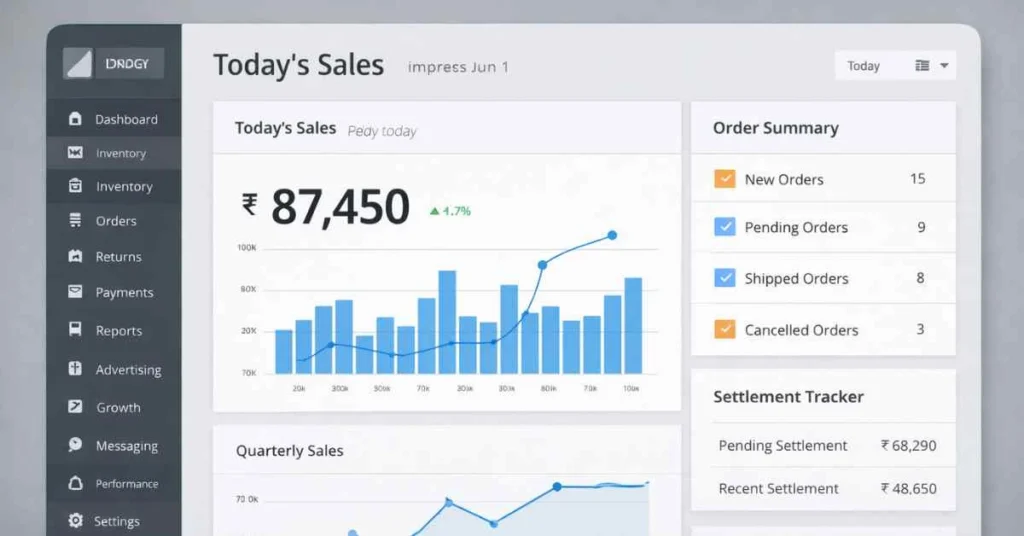
Dashboards are built to show activity, not outcomes. They track orders, sales value, and performance trends so sellers can monitor operations in real time.
What they do not show is the complete cost impact of each order after settlements, returns, and adjustments.
Many sellers assume that positive dashboard numbers reflect real profit.
This assumption is risky.
Dashboards indicate movement and direction, but they are not designed to confirm what actually remains once everything is settled.
This difference becomes clearer when sellers review official fees and settlement documentation, such as Amazon seller fees and settlement deductions.
The Silent Gap Between Expected Profit and Settlement

Revenue in e-commerce is visible immediately. The moment an order is placed, the sale is recorded and reflected across dashboards. Deductions work differently.
Fees, shipping charges, returns, weight adjustments, and penalties are applied later, often across multiple settlement cycles.
This timing mismatch makes profit appear larger than it really is.
Settlements add to the confusion by bundling many adjustments together. Multiple orders, returns, and charges are merged into a single payout, making it difficult to trace where money was actually lost. Individual issues disappear inside summaries.
Over time, many sellers stop reconciling settlements in detail. The process feels time-consuming and mentally exhausting, especially when sales volume increases.
Small mismatches are ignored because they seem manageable.
The problem is that these small differences do not stay small. They repeat across orders and weeks. Gradually, the gap between expected profit and actual cash widens until sellers realize that steady sales never translate into financial comfort.
Costs That Don’t Hurt Individually, but Destroy Margins Together
Most cost elements in e-commerce look harmless when viewed one by one. A small fee here, a return there, a slight increase in shipping does not feel dangerous.
The problem appears when these costs stack together. Individually manageable expenses combine into a steady drain, slowly eroding margins without creating any single moment of alarm.
This is especially visible in marketplaces where charges vary by slab and service, as outlined in the Flipkart seller fees and commission structure.
RTO and Returns Change the Economics, Not Just the Workflow
Average RTO numbers often create false comfort. They hide how sharply return behaviour changes across categories and price ranges.
Low-priced or impulse products tend to absorb returns poorly, while high RTO categories suffer repeated losses.
When revenue is reversed but most costs remain, some products never recover their full expense.
This is especially common in models where sellers rely on surface-level margins instead of Meesho pricing calculation beyond surface margins.
Over time, these products continue selling, but each cycle quietly weakens profitability instead of improving it.
Shipping Slabs, Weight Disputes, and Reverse Logistics
Shipping costs rarely stay fixed. Small changes in weight or dimensions can push orders into higher slabs without clear warning.
These charges usually appear after delivery or return, not at the time of sale. Because the deduction feels delayed and disconnected, sellers rarely link it back to pricing decisions.
Over time, products remain priced for lower slabs while actual costs quietly move higher.
This is why Flipkart selling price calculation with all costs becomes essential once volume increases.
GST Balanced on Paper, Messy in Real Cash Flow
GST often looks neutral in theory. Input credit is expected to offset tax paid, and many sellers assume the balance will correct itself over time.
In practice, expenses are paid immediately, while credits arrive later or get delayed.
This creates a cash flow gap that is easy to underestimate.
Returns, failed deliveries, and cancelled orders complicate this further. Tax adjustments do not always move in sync with reversals, and some credits remain blocked or slow to reflect.
Sellers continue operating while waiting for corrections that feel uncertain.
The belief that GST will settle later is risky because day-to-day operations depend on available cash, not accounting balance.
Official GST rules applicable to e-commerce sellers in India explain the framework, but they do not remove the working capital pressure sellers face in practice.
Over time, GST does not cause visible losses, but it quietly tightens working capital and increases financial pressure.
Why Popular Advice Sounds Right but Fails in Practice
Most e-commerce advice is built around simplified logic. Increase orders, optimize ads, reduce visible costs, and profit should follow.
On the surface, this sounds reasonable and often works in controlled examples. The problem appears when real conditions introduce variation.
Popular advice rarely accounts for delayed deductions, fluctuating return rates, or changing fee structures. It assumes stable inputs in a system that constantly shifts.
Sellers follow this guidance, see short-term improvement, and feel reassured. The underlying issues remain untouched.
As volume grows, hidden costs scale faster than expected. What once felt manageable becomes stressful.
When advice fails, sellers blame execution rather than questioning the assumptions behind the guidance.
This is why many sellers work harder without feeling more secure.
Advice is not wrong by itself. It becomes unreliable when applied without understanding where it stops working in real marketplace conditions.
The Real Reason Sellers Realise the Problem Too Late
Sellers usually track what is easiest to see. Orders, revenue, and daily activity feel concrete and reassuring.
What actually matters takes more effort to understand and is often postponed.
Full reconciliation feels complex, time-consuming, and uncomfortable, especially when sales are growing.
Because of this, small losses are ignored. A few weak settlements do not feel alarming. Over time, these losses repeat quietly across weeks and months. Nothing breaks in one moment.
When pressure finally becomes visible, it feels sudden. Cash dries up, stress rises, and confidence drops. In reality, the collapse was slow and predictable.
It only felt sudden because the warning signs were scattered and easy to avoid until they became impossible to ignore.
A More Honest Way to Look at Profitability
Profit becomes meaningful only after settlements are complete.
Anything calculated before that is an estimate, not a result. Sellers who rely on early numbers often mistake possibility for certainty.
A healthier approach is to think in ranges rather than exact figures. Returns, fee changes, and shipping variations make precision unreliable.
Accepting this uncertainty early prevents false confidence later.
Clarity matters more than optimism because it allows better decisions.
Tools that focus on post-settlement outcomes, such as an Amazon profit after settlement calculator, Flipkart post-settlement profit calculator, or a Meesho pricing calculator with return impact, help sellers understand limits before scaling.
Optimism pushes growth. Clarity decides whether that growth can survive.
Closing Perspective
This problem is rarely a personal failure. It is structural. Marketplace systems make activity visible and outcomes delayed, which naturally leads to confusion.
Most sellers do not lose money because they lack effort or discipline. They lose because the system rewards movement more than clarity.
The sellers who survive long term are not luckier or unusually skilled.
They simply learn to see money differently. They stop trusting early signals and focus on what remains after everything is settled.
When profit is treated as an outcome instead of an assumption, the business becomes quieter, slower, and far more stable.