
Checking product profitability before selling online sounds straightforward. Add up costs, compare them to the selling price, and see what remains. In practice, this is where many sellers get misled.
Profit often looks clear at the planning stage, when numbers are neat, and assumptions feel reasonable.
The real test begins later, once orders face returns, ads start influencing behaviour, and settlements introduce adjustments that were not visible upfront. What appeared profitable on paper slowly becomes uncertain in execution.
This is why many sellers feel confident before listing a product and confused a few weeks later. The issue is not effort or intent. It is the way profitability is commonly checked.
Understanding how to evaluate profit without relying on guesswork requires a different way of thinking, not just better calculations.
Why Profitability Feels Harder Than It Should Be
Profitability feels difficult, not because sellers lack information, but because too many variables affect the outcome at different stages. Costs are not fixed, buyer behaviour is unpredictable, and marketplace rules change quietly.
What looks manageable in a spreadsheet starts behaving differently once real orders begin flowing.
Another reason is the delay. Revenue appears instantly, while many costs show up later through settlements, returns, and adjustments. This gap makes early decisions feel correct even when they are incomplete.
By the time the full picture becomes visible, assumptions have already hardened into habits.
Conflicting advice adds to the confusion. One source recommends strict margin rules, another pushes volume, and a third suggests ads will solve everything.
Each sounds logical in isolation, but real marketplaces do not operate in isolation.
Simple answers fail because they assume stable conditions. Online selling is dynamic. Profitability depends on how variables interact over time, not on a single clean calculation made at the start.
How Most Sellers Check Profitability Today (And Where It Breaks)
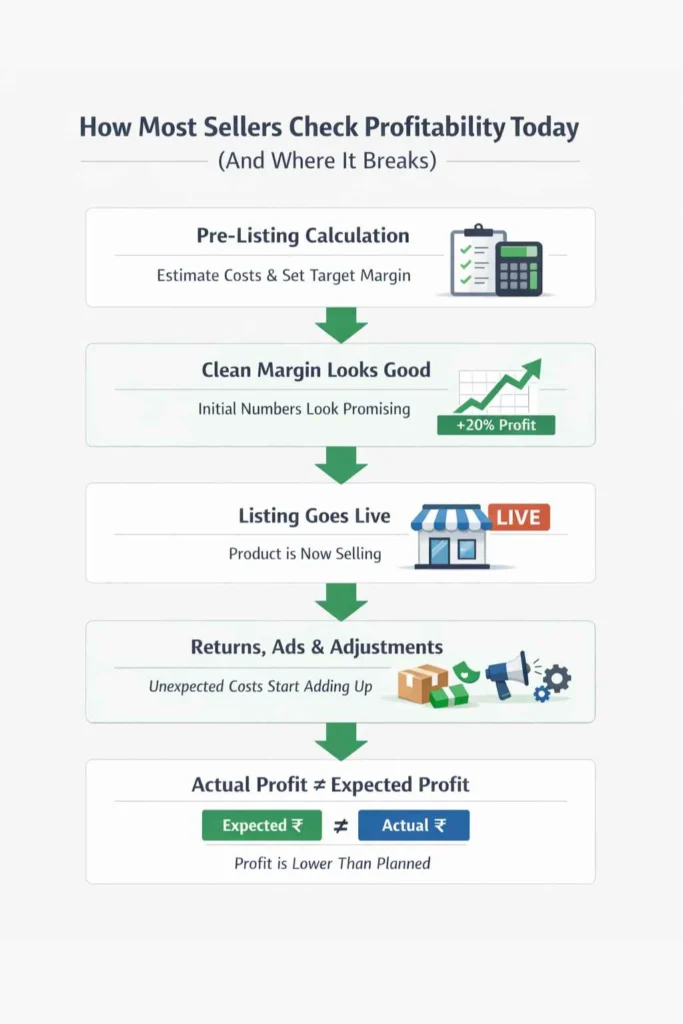
Most sellers begin by following widely shared advice. They calculate expected profit before listing, use a calculator, and aim for a safe-looking margin.
This approach feels sensible and is often encouraged by blogs, videos, and platform tools. It provides quick reassurance and a clear number to work with.
The problem is not that this method is wrong. It is incomplete. These checks assume stable costs and ideal outcomes. Real marketplaces behave differently.
The gaps appear once selling begins, when assumptions meet real buyer behaviour and delayed costs.
One-Time Calculations Create False Confidence
Pre-listing profitability is usually checked once, using clean assumptions. Sellers estimate product cost, add visible fees, and decide that the remaining margin is acceptable.
At this stage, numbers behave politely. Nothing has gone wrong yet, so the result feels reliable.
The problem is that these calculations are static. They assume smooth delivery, stable costs, and predictable buyer behaviour.
Early numbers feel safe because they are taken before any stress enters the system. Confidence builds quickly, even though the calculation has not been tested against real conditions.
This is why understanding how to calculate selling price correctly on Amazon requires looking beyond pre-listing math and into post-settlement reality.
Calculators Show Possibility, Not Outcome
Profit calculators are built on assumptions. They expect accurate inputs, stable fees, and predictable outcomes. When these conditions hold, the results look clean and convincing.
What calculators cannot know is how buyers will behave, how return rates will shift, or how costs will change after listing.
Sellers trust calculators because they offer certainty in a complex environment. A single number feels easier to act on than a range of possibilities.
The risk is not in using calculators, but in treating their output as a guaranteed outcome rather than a rough starting point.
What Profitability Actually Depends On in Real Conditions
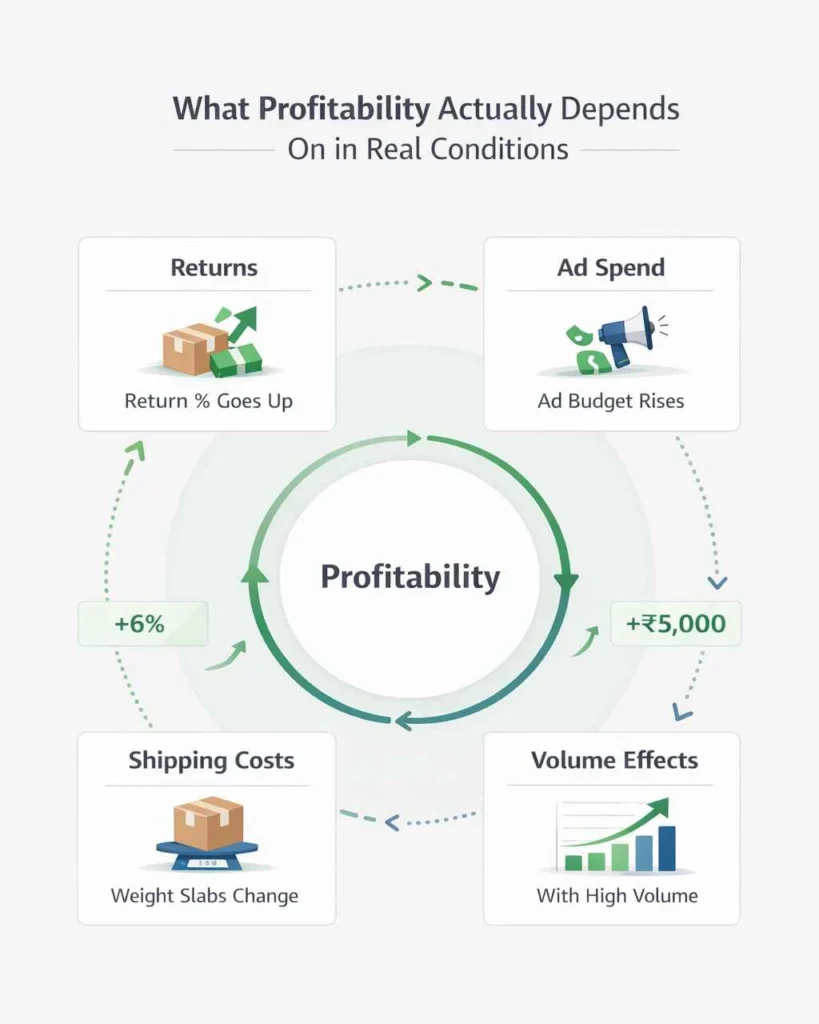
Profitability in real marketplaces is not decided by a single calculation. It depends on how a product performs once it interacts with buyers, logistics, and platform rules.
Outcomes shift as volume increases, behaviour changes, and costs reveal themselves over time.
Instead of thinking in fixed numbers, profitability needs to be viewed as a moving result. Small changes in return rates, ad spend, or shipping can alter outcomes significantly.
What matters is not whether a product looks profitable once, but whether it can remain profitable as conditions fluctuate.
This shift in thinking moves sellers away from certainty and toward resilience, which is where sustainable decisions begin.
Failure Is Part of the System, Not an Exception
Returns, RTO, and cancellations are not rare events in e-commerce. They are built into how marketplaces function. Even well-priced products experience failed deliveries, customer refusals, or reversals that undo revenue while leaving many costs intact.
Ideal delivery assumptions fail because they ignore human behaviour and operational friction. Buyers change their minds, addresses are incomplete, and logistics do not always go as planned.
Profitability that depends on everything going right is fragile.
Realistic checks account for failure as a normal outcome, not as an occasional anomaly.
Costs Do Not Arrive at the Same Time as Revenue
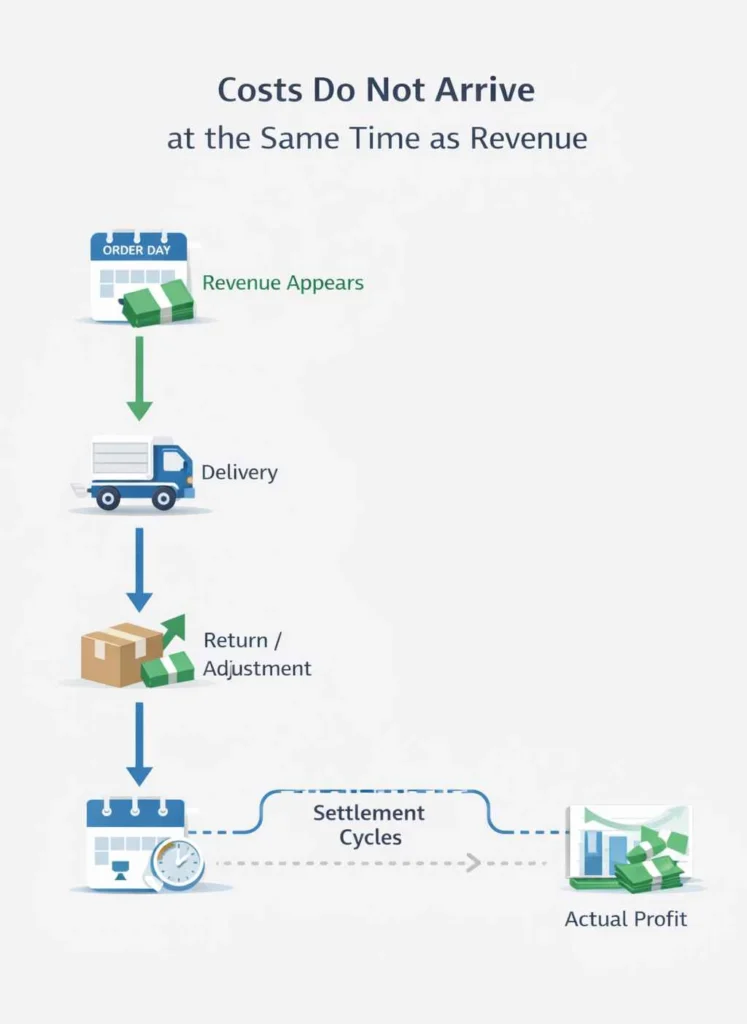
Revenue is recorded the moment an order is placed, which creates an early sense of success. Costs follow a different timeline.
Shipping adjustments, returns, failed deliveries, ad charges, and penalties are applied later through settlements, often spread across multiple cycles.
This delay makes the paper’s profit look healthier than it truly is. Sellers see positive numbers upfront and assume the outcome is secure.
By the time deductions surface, decisions have already been made based on incomplete information, and the real margin feels smaller than expected.
This timing gap exists because platforms apply multiple adjustments after delivery, as outlined in the Amazon seller fees and settlement structure.
Many sellers discover this timing gap only after revisiting their Flipkart selling price calculation and comparing expected margins with actual settlements.
How to Check Product Profitability Without Guesswork
Checking profitability without guesswork starts with letting go of the idea that profit is a single, exact number. In real conditions, outcomes vary.
A safer approach is to think in ranges. What does the product earn in the best case, what happens in an average week, and what does it look like when things go wrong?
This shift changes how decisions are made. Instead of asking whether a product is profitable, the better question becomes whether it can survive failure.
Returns, RTO, and delayed costs should be treated as expected events, not surprises. Profit must be evaluated after adjusting for these outcomes, not before.
Margin buffers matter more than precise calculations. Exact numbers create false confidence, while buffers create room for error. When pricing allows for setbacks, the business absorbs stress without breaking.
Uncertainty is safer than precision because it forces caution.
Sellers who plan for variability stay in control, while those who rely on perfect assumptions are often caught off guard once real selling begins.
What to Evaluate Before Listing a Product
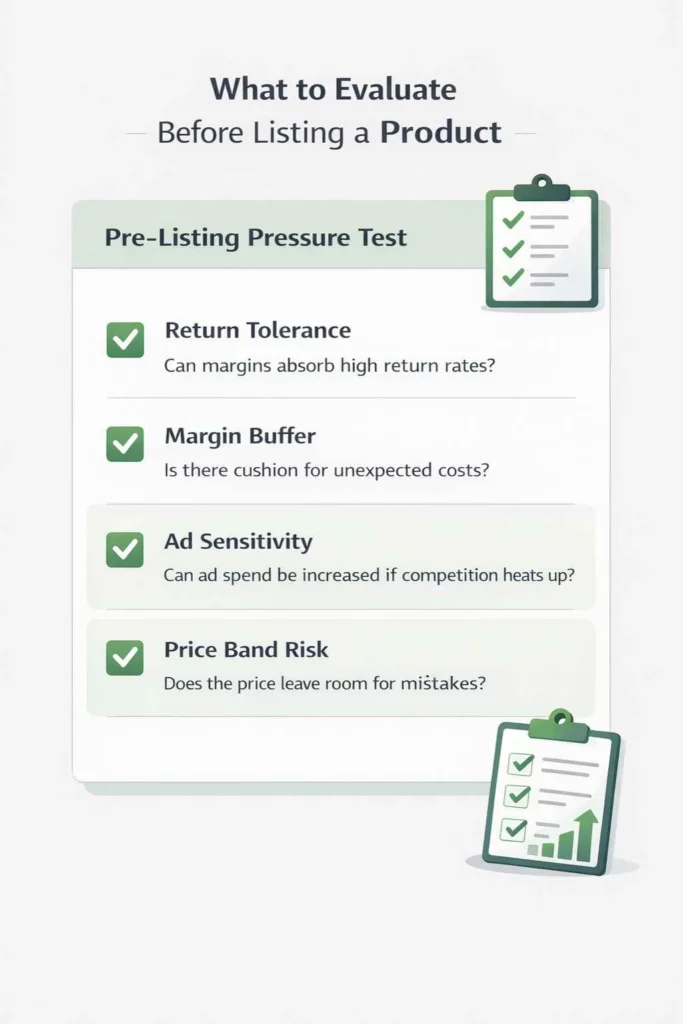
Before a product goes live, profitability decisions are often made quickly. Sellers focus on whether the price looks competitive and whether the margin appears acceptable on paper.
What is often missing at this stage is risk screening. Pre-listing evaluation should not be about optimism.
It should be about pressure testing assumptions.
The first step is to look beyond ideal conditions. A product that works only when delivery is smooth and returns are low, is already fragile.
Pricing must be tested against scenarios where things do not go as planned. This includes higher return rates, rising ad costs, and variations in shipping.
Another critical factor is whether the product has room to absorb mistakes. Tight margins leave no space for learning or adjustment once selling starts.
Products with slightly lower demand but stronger buffers often perform better over time than fast-moving, low-margin items.
Pre-selling clarity comes from asking uncomfortable questions early. Products that fail basic risk checks before listing rarely improve with volume. Early caution prevents long-term stress and capital drain.
Pricing Without Worst-Case Thinking Is Fragile
Pricing often works under ideal conditions, when deliveries are smooth, and costs stay predictable. The weakness shows up under stress.
A small rise in returns, a slight increase in ad spend, or a change in shipping slabs can erase the entire margin.
Without worst-case thinking, prices are set too close to the edge. What looks profitable in calm conditions has no buffer when reality shifts.
Sustainable pricing is not built for perfect scenarios. It is built to survive minor disruptions without turning routine sales into losses.
Category and Price Band Matter More Than Expected
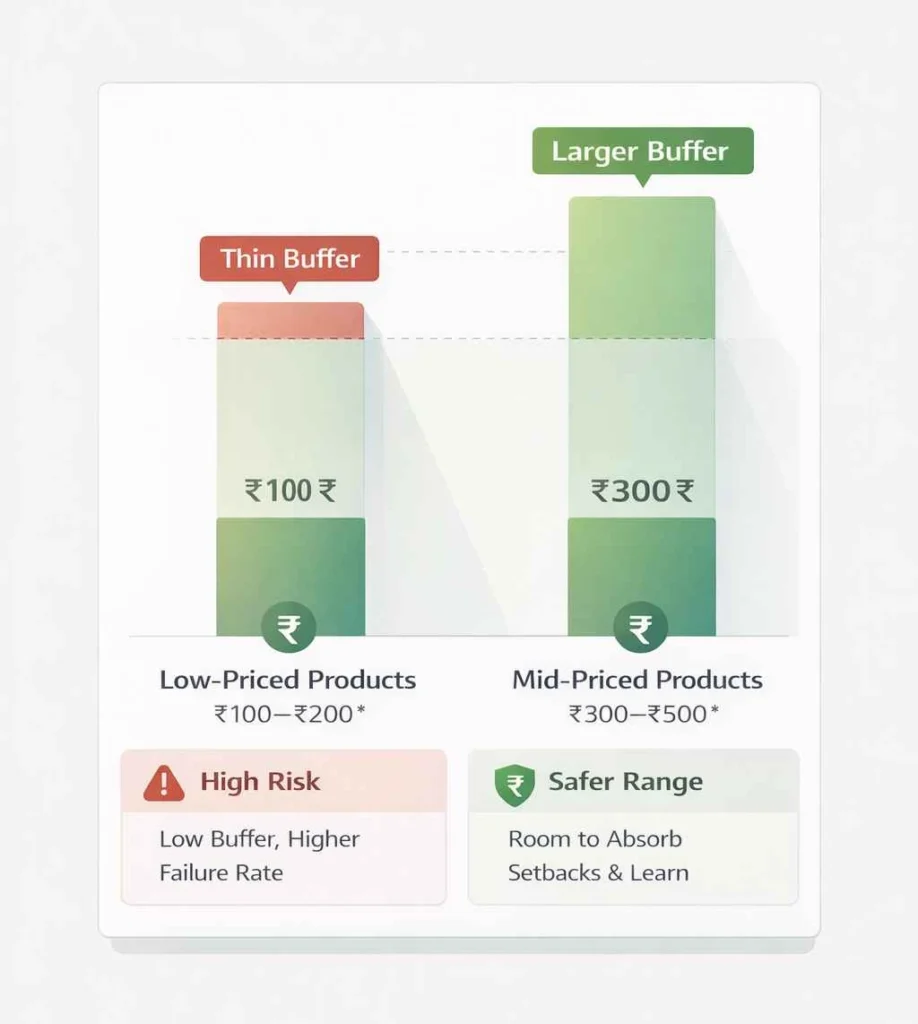
Not all products carry the same risk. Low-priced items are especially fragile because even small cost changes or returns consume a large portion of the margin.
There is little room to recover losses once something goes wrong.
High-return categories add another layer of pressure. Frequent reversals turn otherwise healthy-looking products into slow drains on cash. Industry averages often hide this reality.
They smooth out extremes, but sellers operate at the category and price-band level, where outcomes can differ sharply from the “average” experience.
This sensitivity becomes clearer when reviewing a proper Meesho selling price calculation, where low price bands leave little room for error.
What to Monitor Once Selling Starts
Once a product goes live, profitability shifts from planning to observation. This is where many sellers relax too early. Early orders create reassurance, but real signals emerge only after patterns begin to form.
Monitoring should move beyond order counts and focus on what each cycle of selling reveals.
Settlement behaviour is one of the first indicators. When expected margins and actual payouts begin drifting apart, it is rarely a one-time issue.
Small gaps often repeat. Another signal is how effort changes with volume. If managing the product feels heavier as orders increase, costs are likely rising faster than expected.
Seller behaviour also matters. Avoiding detailed reviews of settlements or delaying adjustments is often a sign that something feels uncomfortable but unclear. Over time, these ignored signals compound.
Post-listening monitoring is not about reacting to every fluctuation. It is about noticing direction. Products that remain stable under normal variation are worth scaling.
Products that feel increasingly fragile with volume usually need correction or early exit before losses grow quietly.
Early Signals That a Product Is Quietly Failing

One of the earliest signs of trouble is a growing gap between expected profit and actual settlements. Payouts arrive slightly lower than planned, then lower again, without a clear explanation.
Alongside this, adjustments begin to rise. Returns, weight disputes, and miscellaneous deductions appear more frequently and stop feeling random.
Another signal is behavioural. Sellers start postponing detailed checks, skim settlement reports, or rely onthe hope that numbers will improve on their own.
This quiet avoidance usually appears before serious losses. When discomfort grows but clarity does not, it is often a sign that the product is weakening beneath the surface.
Why Profitability Must Be Rechecked Continuously
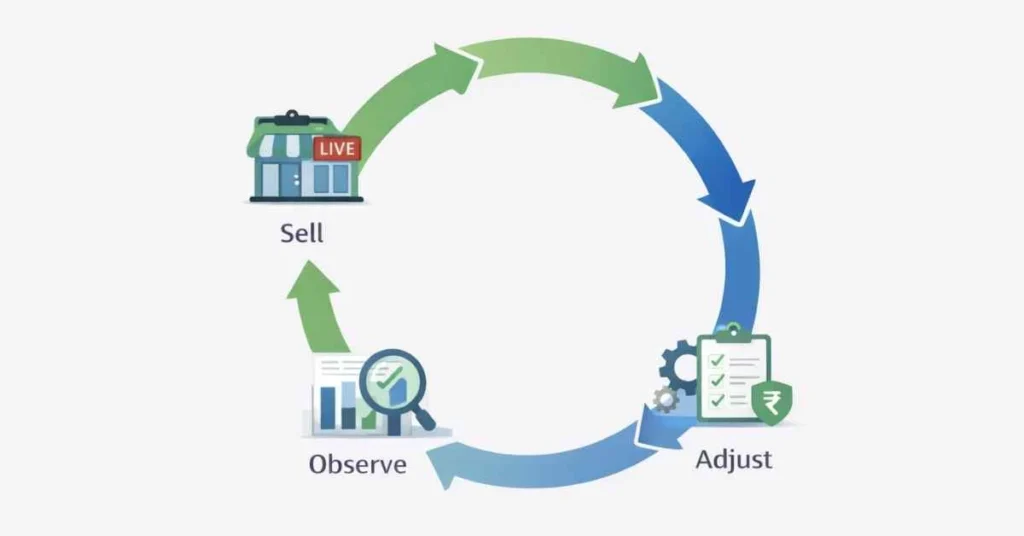
Profitability changes as behaviour changes. Buyer expectations shift, return rates fluctuate, and advertising begins influencing who places orders.
What worked during early sales often reflects a narrow set of conditions that do not hold at scale.
Volume introduces new effects. Shipping slabs change, adjustments become more frequent, and small inefficiencies multiply.
A product that was profitable in its first few weeks can quietly drift into a loss as these factors compound.
Relying on the fact that a product worked once is dangerous.
Past performance reflects a moment in time. Continuous checks are needed to confirm that the underlying economics are still holding as conditions evolve.
When a Product Should Be Rejected, Not Optimized
Not every product is meant to be fixed. Some products fail because their economics are weak, not because execution is poor. When margins disappear even under conservative assumptions, no amount of optimization can create stability.
Returns, fees, and shipping costs simply outweigh what the price can realistically support.
Scaling such products often makes the situation worse. Higher volume multiplies losses, increases cash pressure, and amplifies stress. What feels like progress on dashboards turns into faster capital drain behind the scenes.
Rejecting a product early is not a setback. It is a protective decision. Stopping before losses deepen preserves working capital and mental clarity.
Sellers who build sustainable businesses are not those who optimize everything. They are those who recognize which products deserve effort and which ones are better left behind before confidence and resources erode.
What Not to Trust Blindly When Checking Profitability
Some profitability shortcuts feel reassuring but often create blind spots. Flat margin rules are one example. A fixed percentage may work in theory, but it ignores category risk, price sensitivity, and return behaviour.
What looks safe on paper can collapse under normal variation.
Industry averages create a similar illusion. They smooth out extremes, but sellers do not operate in averages. They operate in specific categories, price bands, and customer segments where outcomes can be very different.
Influencer pricing formulas add another layer of risk. These methods are usually simplified, context-free, and based on limited scenarios. They rarely reflect long-term performance.
Copying competitor prices is equally dangerous. Competitors may be operating with different costs, goals, or loss tolerance.
Blind trust reduces judgment. Profitability improves when sellers question shortcuts and evaluate decisions based on their own conditions, not borrowed confidence.
A Clearer, Safer Way to Think About Profitability
A more reliable way to think about profitability starts with shifting the reference point. Profit only becomes real after settlements are complete.
Anything before that is an estimate that still carries risk. Treating early numbers as final results creates false certainty and poor decisions.
Replacing exact figures with ranges brings clarity. Instead of asking how much a product will earn, it is safer to ask what it earns in good conditions, average conditions, and stressed conditions.
These ranges reflect reality more honestly than a single number ever can.
This approach also restores control. When expectations are grounded, excitement no longer drives decisions. Pricing, scaling, and spending slow down, but they become deliberate. Growth stops being urgent and starts being intentional.
Sellers who want to apply this thinking practically often use tools like an Amazon selling price calculator, a Flipkart selling price calculator, or a Meesho selling price calculator to test pricing against real marketplace conditions instead of ideal assumptions.
Clear thinking beats fast growth. Sellers who prioritize decision clarity over speed are better prepared to handle variation, absorb setbacks, and build businesses that feel stable rather than constantly reactive.
Closing Perspective
Profitability in e-commerce is rarely about luck. It is shaped by judgment under uncertainty. Costs shift, behaviour changes, and outcomes unfold over time, not all at once.
Sellers who struggle are often not careless. They are operating with incomplete signals and optimistic assumptions.
Those who survive learn to notice risk earlier. They question clean numbers, watch how reality behaves, and adjust before pressure builds. Their advantage is not better tools or secret strategies.
It is the ability to stay calm when results are uncertain and make decisions based on what is likely, not what is hoped for.
Over time, this mindset turns unpredictability into something manageable and sustainable.